Beyond the Postcard: A Photographer’s Guide to New Zealand

Even for a seasoned mountain photographer like Matt Payne, a first trip to New Zealand’s South Island brings plenty of surprises. Working alongside local Pro Neil Protheroe, Matt breaks down how to navigate autumn when the trees don’t change color, how to handle white balance when the lakes look impossibly blue, and how to pull a unique frame out of a crowded scene at the Wanaka tree.

Quick Links: Evergreen Autumn Forests | Glacial Water White Balance | The Wanaka Tree Crowds | FAQs

If New Zealand has a signature stereotype, it’s got to be the sheep. People love pointing out that they outnumber humans by nearly five to one. Coming from southwest Colorado, where sheep still graze the nearby San Juan Mountains, livestock isn’t exactly a novelty to me. But like most photographers visiting somewhere for the first time, it’s hard not to arrive carrying a mental gallery of expectations.

It’s one of the reasons I deliberately avoid studying other photographers’ work before travelling anywhere new. I don’t want to have tunnel vision or arrive with a pre-composed shot list. What I want is to experience a landscape with completely fresh eyes and let my own curiosity dictate what I photograph. For me, that often means gravitating toward smaller, quieter vignettes instead of simply recreating the iconic grand scenes everyone else has already photographed.

As it turned out, I actually saw more sheep on my trip to Scotland than I did in New Zealand. What caught me off guard was, perhaps surprisingly, the landscape itself.

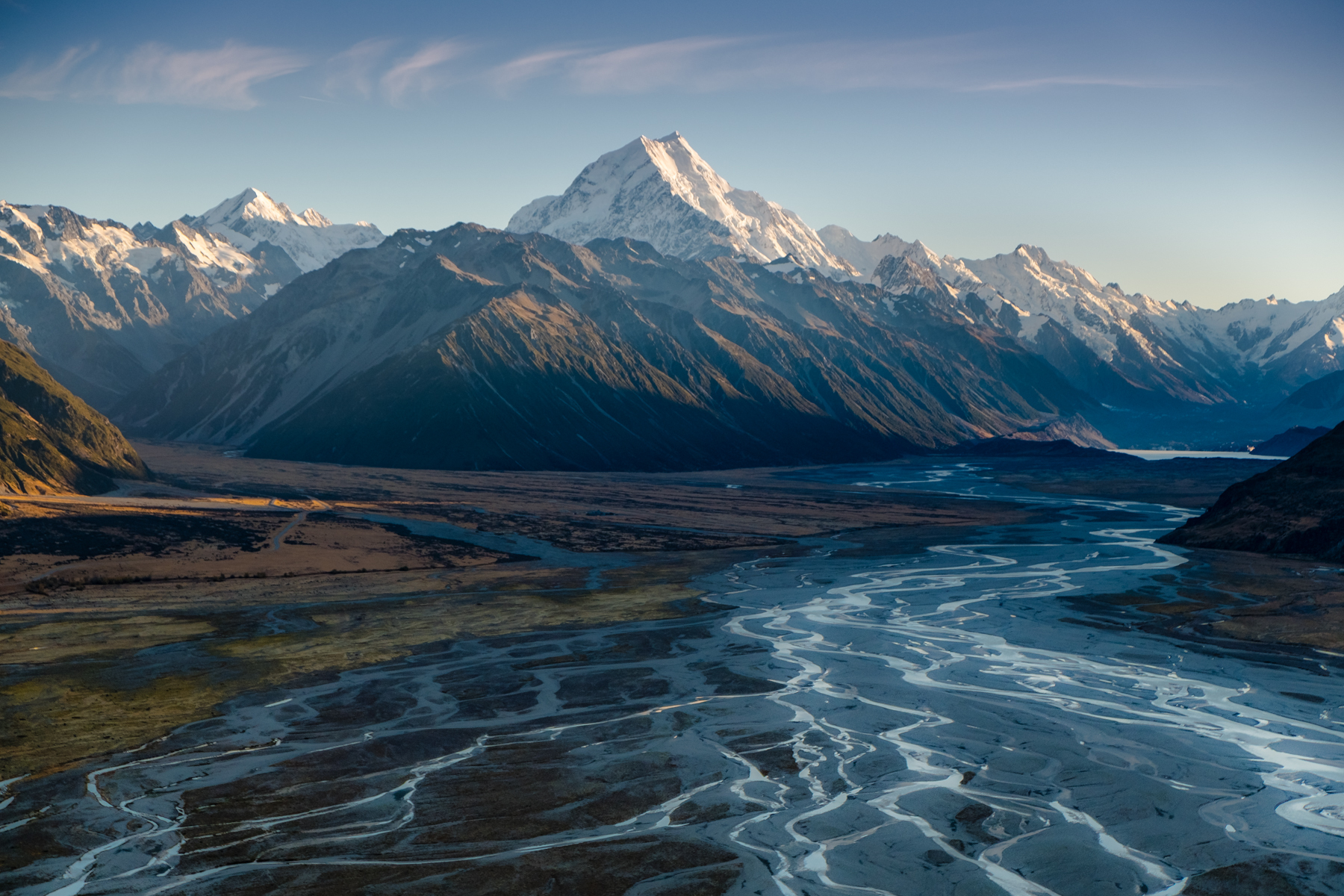
Panoramic view of Aoraki / Mount Cook rising above the braided riverbeds of the Tasman Valley in New Zealand's South Island. Snow-capped peaks glow in warm early morning light beneath a clear blue sky, while silver glacial streams wind across the expansive valley floor toward the mountains.
Early morning light over the braided Tasman River. Shot at f/4, 1/1000", ISO 320

Photographing New Zealand’s Southern Alps

I knew New Zealand had mountains, of course, but for some reason I didn’t expect them to be quite so enormous or rugged, not to mention packed with glaciers. In geological terms, it was the prominence that struck me, which is the massive vertical distance between the flat basin floor and the peaks above. Because the mountains sit so high relative to where you’re standing on the ground, they catch the early morning and late evening light a lot earlier than I’m used to, living in Colorado. The sheer scale of the Southern Alps, which run like a backbone along much of the length of the South Island, creates incredible opportunities for telephoto shots of the peaks catching those first rays.

Aoraki / Mount Cook catches the first light of sunrise, its snow-covered summit glowing pink above the calm waters of Lake Pukaki. Soft pastel clouds stretch across the sky while the winding lakeside road and golden tussock-covered hills frame the peaceful South Island landscape.
Lake Pukaki toward Aoraki/Mount Cook. Shot at f/16, 130", ISO 50
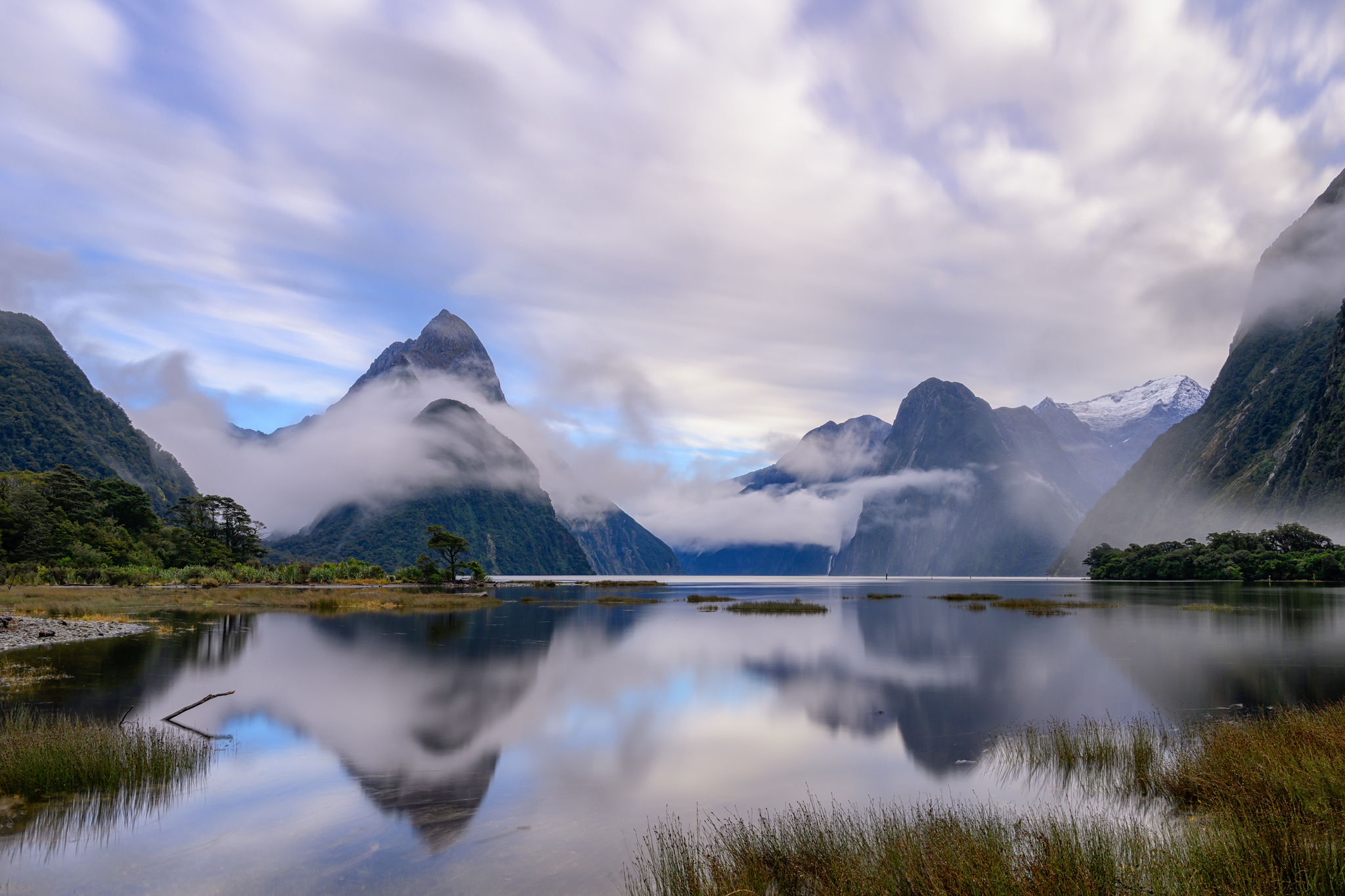
Long-exposure view of Milford Sound in Fiordland National Park, New Zealand, with mist swirling around Mitre Peak and surrounding mountains. Calm water reflects the dramatic peaks and fast-moving clouds, while low fog drifts across the fjord beneath a soft blue and grey sky.
Milford Sound in Fiordland National Park. Shot at f/8, 30", ISO 80

Standing on the shores of one of New Zealand’s massive lakes and seeing those huge peaks reflected in the water is incredible. It’s an ideal opportunity to put on a telephoto lens, zoom right in on the mountain ranges, and frame up reflections, water, trees, and peaks to interpret the scale of the grand landscape from ground level. But to really understand the sheer magnitude of that terrain, you have to get above it.

Aerial Photography in New Zealand

Neil Protheroe, our local team member, knows New Zealand inside and out. He has one of the most interesting backstories of anyone on the Muench Workshops team. He went to Paris on vacation at 18, decided he wanted to stay, worked in a restaurant without knowing a word of French, and a decade on, ended up fluent! He’s jovial, deeply passionate about local food culture, and he understands the nuances of New Zealand weather. He would watch the forecasts closely to pick the absolute best day for our helicopter flight to ensure we had the perfect photography conditions.

Flying doors-off in a helicopter at 11,000 feet, surrounded by the massive faces of Mount Cook (or Aoraki, as Neil kept reminding me), is an unbelievable experience. Drones are illegal in that part of New Zealand due to heavy air traffic, and at that altitude, flying one would be practically impossible anyway.

Up in the chopper, you weave alongside jagged walls of rock and ice, getting remarkably close to hanging glaciers, icefalls, and sheer alpine faces with light smashing into them. As a photographer, it’s a thrilling exercise in fast composition. Because you don’t control the flight path, you’re constantly anticipating how ridges, ice features, and background peaks will line up, previsualizing your frame in real time to make the absolute most of the route you’re given.

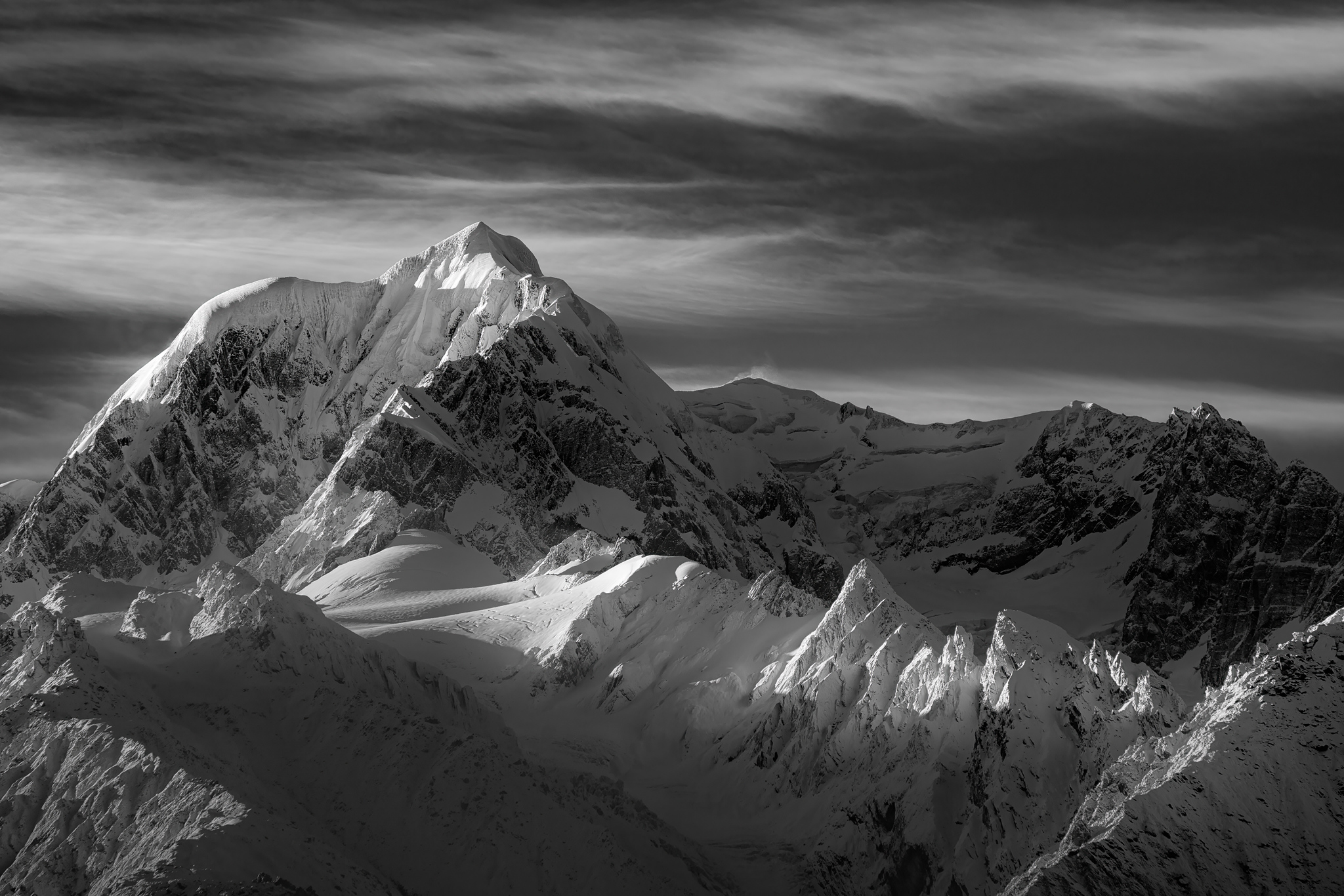
Black-and-white photograph of snow-covered peaks in New Zealand's Southern Alps, with dramatic light illuminating the rugged summit and glaciated ridges. High-contrast clouds sweep across the dark sky, emphasizing the scale, texture, and stark beauty of the alpine landscape.
Mount Tasman. Shot at f/5.6, 1/160", ISO 100
Close-up aerial view of a snow-covered peak in New Zealand's Southern Alps, revealing steep ridges, wind-sculpted snow, and deep crevasses beneath a cloudless blue sky. Bright alpine light highlights the mountain's dramatic textures and sheer scale.
The west face of Aoraki/Mount Cook. Shot at f/5.6, 1/1600, ISO 100

Looking down from the helicopter, you fly directly over both Lake Pukaki and Lake Tasman, with the braided rivers running in the gap between them. It’s beautiful to watch Tasman’s aquamarine, silt-heavy water meet Pukaki’s more traditional, deeper blue: the two tones interplay right at the point where one lake feeds into the other.

Capturing Glacial Blue Lakes

The distinctive colors of these lakes are caused by glacial silt (a fine rock flour created as grinding glaciers crush the bedrock), which is carried down to the lakes in the meltwater. That suspended silt completely changes the character of the water, and when the blue sky reflects off it, it enhances the tones so intensely that it can look unreal. People seeing photographs of these lakes for the first time often ask if the color is exaggerated in post-production.

When it comes to color correcting my raw files, I look for a clean neutral target in the scene to keep the tones authentic to what I saw in person. I leave my camera on Auto White Balance when shooting, and in post-processing, I use a true neutral—whether that’s snow on surrounding peaks or the dry white sand and silt banks in aerial shots—as my reference point. Once the neutrals read cleanly, the brilliant aquamarine of the water reveals itself naturally—no exaggeration required.

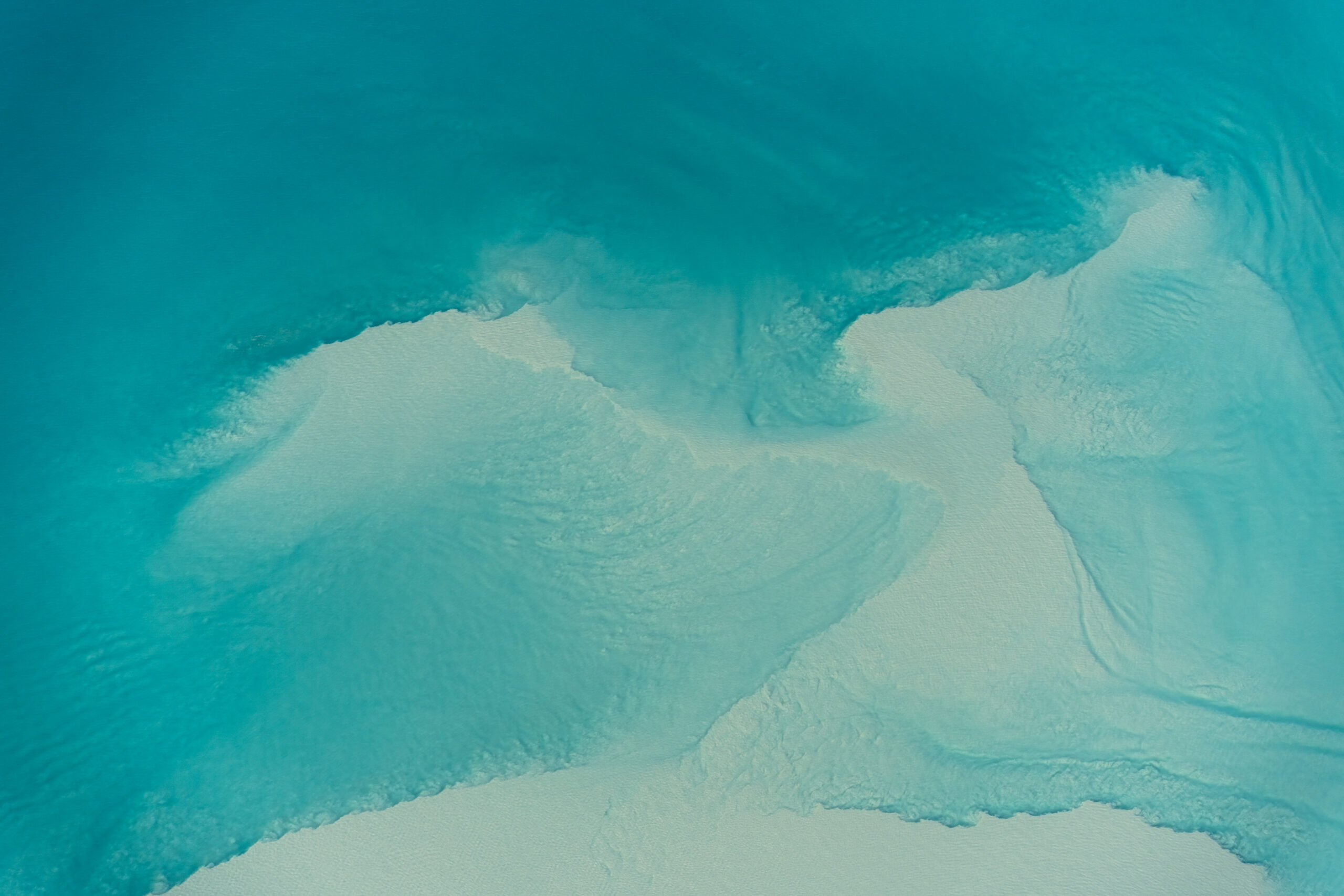
Abstract aerial view of turquoise glacial water flowing over pale sandbars, creating swirling patterns and soft gradients of blue and white. The natural shapes resemble flowing brushstrokes, highlighting the textures and movement of the braided river.
The Tasman River meets Lake Pukaki. Shot at f/5.6, 1/1600", ISO 500
Autumn trees in shades of gold and green line the shore of Lake Ruataniwha in New Zealand's Mackenzie Basin. Their colorful foliage is reflected in the lake's striking turquoise water, creating a serene scene of contrasting blues and autumn tones.
Lake Ruataniwha. Shot at f/14, 3.2", ISO 100

Autumn Photography in New Zealand’s Forests

We run this workshop in both spring and autumn because each season shows you a different side of the country. One of the most fascinating aspects of photographing New Zealand in autumn is how rapidly the landscape changes between completely different ecosystems. In the high-country basin around Twizel, which sits in the lee of the Southern Alps, planted poplars turn brilliant shades of yellow in autumn.

But move over to the glacial valleys of Fiordland on the southwest coast and the scenery transforms into dense, ancient rainforests made up of mountain beech trees that stay green year-round. You find that same lush contrast further north near Fox Glacier, where rainforest sits directly at the foot of massive alpine peaks like Mount Tasman.

Golden autumn poplars and willows surround a winding dirt track near Macetown, New Zealand, with rugged schist hills rising behind. Warm morning light illuminates the vibrant yellow foliage, contrasting with the dry, grey-brown landscape of Central Otago.
Autumn colors in Central Otago. Shot at f/6.3, 1/80", ISO 100
Mist drifts through the rainforest of Fiordland National Park, New Zealand, as twisted native trees fill the foreground and steep mountains rise behind them. A snow-covered peak emerges beneath heavy clouds, capturing the region's wild, rain-soaked atmosphere.
Native trees in Fiordland National Park. Shot at f/13, 1/80", ISO 100

Rainforest Composition Tips

Photographing an autumn season in a perpetually green rainforest forces a shift in mindset. When you can’t rely on bright foliage to create easy contrast, composition becomes entirely about the metaphors, the textures, and the arrangement of elements.

From a distance, looking up at the mountains is a dream setup for telephoto isolation and compression. You can use long focal lengths to stack wild, jungle-like foliage right against glaciated alpine rock, but once you step onto the forest floor, composition becomes a workout in making sense of chaos.

Dense native beech forest in Fiordland National Park, New Zealand, where gnarled, moss-covered trees form an intricate green canopy across the mountainside. Twisted branches and layered foliage create a textured, ancient woodland filled with natural patterns.
Ancient rainforest in New Zealand's West Coast. Shot at f/13, 1/13", ISO 100
Lush temperate rainforest in New Zealand's West Coast, where ancient trees are draped in thick green moss and surrounded by tree ferns. Twisted trunks, dense foliage, and vibrant moss create a rich, primeval forest scene beneath a shaded canopy.
Shot at f/7.1, 1/3", ISO 320

Our workshop group started teasing me because I would keep pointing out dead trees. But to me, a weathered dead tree in a living green forest reads like a portrait. It has human qualities and stands out as a unique subject amidst the green.

Finding clean compositions in a dense forest can be tough for people, but it’s one of the key skills I focus on teaching. To help navigate the clutter, I guide photographers through an iterative process of asking one core question:

“If I include or exclude this element, does it help tell the story of what drew me to this scene, or does it hurt it?”

By continuously asking that question, you learn to exclude messy distractions and isolate what actually caught your attention in the first place.

Mastering Mist and Fog

Fog and mist are a true staple of autumn across the South Island. Neil brought it up early on, pointing out that low-lying atmosphere is a regular part of the season down there, and he wasn’t kidding. Out of the four days we spent shooting around the Twizel and Mount Cook lakes, there was fog rolling through in one direction or another every single day. It was a huge contrast to the dry climate I’m used to at home in Colorado.

Photographically, that low-lying atmosphere becomes an incredible tool. Whether you’re shooting across a quiet lake shore at dawn or watching cloud layers roll over tussock slopes, mist creates natural visual separation, softening background chaos, muting distant clutter, and letting clean foreground shapes stand out.

Morning mist drifts across Lake Ruataniwha in New Zealand's Mackenzie Basin, reflecting a line of autumn trees along the shoreline. Low cloud spills through the surrounding golden hills, creating a calm and atmospheric lakeside scene.
Lake Ruataniwha. Shot at f/11, 1/20", ISO 100
Morning mist hovers above a still lake, reflecting autumn trees in shades of green, gold, and orange, with dry high-country hills rising in the background.
Shot at f/11, 1/40", ISO 100

Finding Unique New Zealand Photo Locations

With so many trip-planning tools available nowadays, it’s easy to think you can just do New Zealand on your own. Why not put a query into ChatGPT and get a list of the iconic spots? You could, but while an algorithm can generate a list and calculate sunrise times, it lacks real-time local nuance. It can’t tell you the best order to visit locations as the sun hits specific peaks, how to adapt when the light changes, or how to find a unique frame when fifty people are standing in the exact same spot.

The Wanaka Tree stands alone in the calm waters of Lake Wānaka, New Zealand, beneath dramatic storm clouds. Golden autumn poplars line the shoreline while mist and low cloud wrap the distant mountains, creating a moody and atmospheric landscape.
Yes, it's That Wanaka Tree. Shot at f/13, 2", ISO 320

Case in point: The Wanaka Tree

We’ve all seen the photographs, and with good reason. A lone willow tree sitting half-submerged in the shallow waters of Lake Wanaka, framed by the rugged backdrop of the Southern Alps.

When we arrived, the conditions were perfect: yellow autumn foliage, blue-shadowed background mountains, and soft light creating a beautiful yellow, blue, and white color story. Naturally, the shoreline had a crowd of photographers out enjoying the morning. I even spotted a few people running wild custom setups, using hot-shoe brackets to stack a second camera directly on top of the first.

But for nearly all of those postcard locations, within 30 to 40 feet of where you stand, there are many other photographs you can capture. All around us the shoreline was lined with incredible poplar trees—super tall, super thick, and full of fall color.

And so once we’d captured the iconic view of the tree, Neil directed us into this incredible little forest right next to it to shoot telephoto isolations and ICM through the canopy.

Getting the classic shot is great, but some of the most creative work that morning came from stepping just a few yards away, where no one else was shooting.

Intentional camera movement photograph of autumn poplar trees near Wānaka, New Zealand. Vertical streaks of blue, gold, and green blur the forest into an impressionistic scene, creating a painterly abstract interpretation of the woodland.
Poplars In Motion. Shot at f/7.1, 4", ISO 320
Wanaka Sunstar. Shot at f/16, 1/80", ISO 100

Coromandel Peak

On our final morning near Wanaka, Neil arranged a 15-minute helicopter ride up to Coromandel Peak, a mid-sized mountain that would otherwise take half a day to hike. We landed on a high ridge just ten minutes before sunrise.

The tufts of tussock grass underfoot were wet from rain the night before, holding beads of moisture that were ready to catch the light. Low clouds smothered the horizon, but just as the sun crested, it fired right through a tiny gap in the cloud deck. For a brief, ephemeral moment, warm golden light illuminated the wet ridge, the mountain face, and a few grazing sheep on the slope.

Then the light faded and the window closed. It was a fleeting moment but one I still think about months later.

Sunrise breaks beneath a dark storm cloud above Lake Wānaka, New Zealand, casting golden light across the lake and surrounding valleys. Tussock grass fills the foreground from the Coromandel Peak viewpoint, while dramatic clouds frame the glowing landscape below.
Fleeting light atop Coromandel Peak. Shot at f/16, 1/13", ISO 320

Is New Zealand Worth the Travel?

To photograph rainforests, ocean coastlines, glaciated mountains, and alpine lakes in the United States, you’d have to drive 40 hours across multiple states. In New Zealand, you have five distinct ecosystems within a 100-mile radius and as a result, you spend far less time driving and far more time with your camera out.

There’s no denying it takes a long time to get to New Zealand from pretty much anywhere in the world, but having that level of landscape diversity crammed into such a small area makes it so worth it.

Interested in exploring New Zealand for yourself? Whether you’re eager to capture the Southern Alps, master the mist in ancient rainforests, or simply discover your own unique perspective far from the crowds, New Zealand offers a landscape unlike anywhere else. Join Neil for our upcoming 10/26 New Zealand in Spring workshop or our 04/27 New Zealand in Autumn workshop.

FAQ

While both islands have plenty to offer, the South Island is widely regarded as New Zealand’s premier destination for landscape photography because of the sheer variety and scale of its scenery.

Within a relatively compact area, you’ll find the Southern Alps, glaciers, turquoise glacial lakes, braided rivers, ancient rainforests, rugged coastlines, and the world-famous fjords of Fiordland. Iconic locations such as Aoraki / Mount Cook, Lake Pukaki, Lake Wānaka, the West Coast, and Milford Sound are all within a day’s drive of one another, allowing photographers to experience dramatically different landscapes without covering huge distances.

The North Island is known for its volcanic landscapes, geothermal parks, giant kauri forests, and dramatic coastlines, making it well worth visiting. However, if your primary goal is photographing mountains, alpine lakes, glaciers, and diverse natural landscapes, the South Island is where most photographers choose to spend the majority of their time.
There isn’t a single “best” season—it depends on the images you want to create.

Spring (October–November) offers snow-covered peaks, powerful waterfalls fed by snowmelt, fresh green landscapes and highly changeable weather, particularly around Fiordland and Aoraki / Mount Cook.

Autumn (April–May) is renowned for golden poplars, colourful willows, morning mist, calmer conditions and crisp mountain light around Wānaka, Twizel and the Mackenzie Basin. It’s also generally quieter than the peak summer months, making it easier to photograph popular locations without large crowds.

Some of the South Island’s most photogenic locations include:

  • Aoraki / Mount Cook National Park
  • Lake Pukaki and Lake Tekapo
  • Lake Matheson
  • Milford Sound and Doubtful Sound
  • Lake Wānaka
  • Fiordland National Park
  • The Hooker Valley
  • The West Coast rainforests
  • The Nevis Valley and Central Otago

Together they offer extraordinary variety, from glaciers and alpine peaks to fjords, braided rivers, ancient rainforest and wide-open high country.

The vivid turquoise colour comes from glacial flour (also called rock flour)—microscopic particles created as glaciers grind against bedrock. These particles remain suspended in the water and scatter sunlight, reflecting blue and green wavelengths more strongly than other colours.

Lakes such as Pukaki, Tasman and Tekapo are among the finest examples of this phenomenon, particularly on clear days or when viewed from above.

Yes. New Zealand’s mountainous terrain creates highly localised weather, particularly on the South Island. Conditions can change within hours, especially around Aoraki / Mount Cook, Fiordland and the West Coast.

For photographers, that’s often an advantage. Fast-moving fronts produce dramatic cloud, mist, rainbows and shafts of light that can transform a landscape. The key is building flexibility into your itinerary rather than expecting every sunrise or sunset to be cloud-free.

A versatile landscape kit is ideal:

  • 16–35mm or similar wide-angle lens for lakes, mountains and fjords.
  • 24–70mm or 24–105mm general-purpose zoom.
  • 70–200mm or longer telephoto for isolating mountain details and compressed landscapes.
  • A sturdy tripod for sunrise, waterfalls, reflections and long exposures.
  • Circular polariser and ND filters.
  • Waterproof camera cover and plenty of spare batteries.

Many photographers arrive expecting to use only wide-angle lenses but discover that telephotos are invaluable for isolating the Southern Alps and creating intimate landscape compositions.

Generally, no.

Most national parks managed by New Zealand’s Department of Conservation require permission (a concession) to fly a drone, and recreational approvals are rarely granted. Additional restrictions often apply near airports, helicopter flight paths and wildlife.

If you’re planning aerial photography, always check the latest DOC regulations and Civil Aviation Authority rules before travelling.

Matt Payne

Written by Matt Payne

Matt Payne is a pro at Muench Workshops, guiding and educating photographers on workshops around the world.

View Matt Payne Profile
Related Workshops

New workshops for 2027!

Join our live webinar for all the details.

Days
Hours
Minutes
Seconds

70+ new workshops, with 20 brand new destinations!

To join us, sign up for the webinar here.

Exclusive Savings Starts Now!

Save $750

Register for any workshop before midnight, December 3, 2024, and we’ll apply the $750 discount to your final balance payment.

Offer valid on new registrations only.

Call For entries!

Your image on our next magazine cover.

This opportunity to showcase your work is only open to folks who have been on a workshop with us. 

Summer Sale!

Save $500

Days
Hours
Minutes
Seconds

Register for any workshop before midnight, July 7, 2025 and we’ll apply the $500 discount to your final balance payment.

Offer valid on new registrations only.

Cyber Monday Sale!

$750 Off Any Workshop

SALE ENDS IN:
Days
Hours
Minutes
Seconds

Save $750 off workshop. New registrations only.
Discount is applied to your final balance payment.
This offer expires at midnight on December 1, 2025, Eastern Daylight Time.